Stinging insect nest neutralization in Wichita prioritizes human safety through immediate chemical isolation rather than slow broadcast misting. Residential architectures in historic districts such as College Hill and…
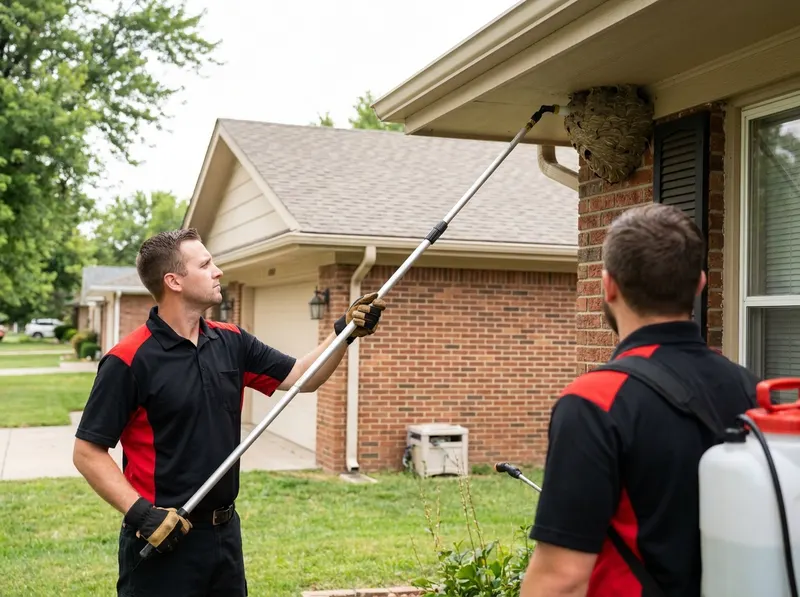
Stinging insect nest neutralization in Wichita prioritizes human safety through immediate chemical isolation rather than slow broadcast misting. Residential architectures in historic districts such as College Hill and Sleepy Hollow often host paper wasps under cedar soffits and decorative porch brackets. Structural cavities in these older wood frames allow aerial colonies to construct expansive paper envelopes behind siding boards. Field application utilizes directional foaming pyrethroids injected directly into entry points. This halts worker defense flights within 60 seconds and prevents internal migration into attic floorboards. The procedure isolates the chemical footprint specifically to the brood comb, leaving living quarters free of airborne residues and safe for domestic animals once the barrier dries.
Ground-nesting yellowjackets present a different physiological profile throughout sandy loam yards near Riverside and South City, particularly along riparian drainage near the Arkansas River. These subterranean nests expand into abandoned rodent burrows and root voids, often housing between 1,000 and 4,000 workers by late August. Applying surface sprays to the ground hole fails because the brood chamber often sits 12 to 18 inches below the turf grade. Professional neutralization employs pressurized micro-granulate blowing equipment that drives insecticidal dust through the entire labyrinth. This neutralizes the egg-laying queen directly beneath the soil crust. Homeowners trade the danger of territorial swarms and mower stings for an exact, mechanical termination of the colony matrix.
Exterior hornets in crown foliage throughout Crown Heights, Forest Hills, and Benjamin Hills require elevated mechanical access tools. Bald-faced hornets build dense cellulose spheres reaching diameters over 14 inches in mature hackberry and elm canopies. Technicians do not blast these hives with high-pressure water streams, which merely fractures the nest and disperses thousands of aggressive foragers into neighboring yards. Operators use calibrated injection rods to pierce the primary envelope, dispersing chemical knockdown agents inside the active core. The physical nest structure is detached, bagged into heavy polyethylene containment, and transported off-site, while a long-lasting micro-encapsulated repellent lines the anchor branch to prevent secondary comb establishment.
Every job gets a firm, written price after a free on-site visit.
Tell us about your stinging insect nest neutralization job in Wichita and we'll send a clear, written quote, usually the same day.
 Halvex Extermination